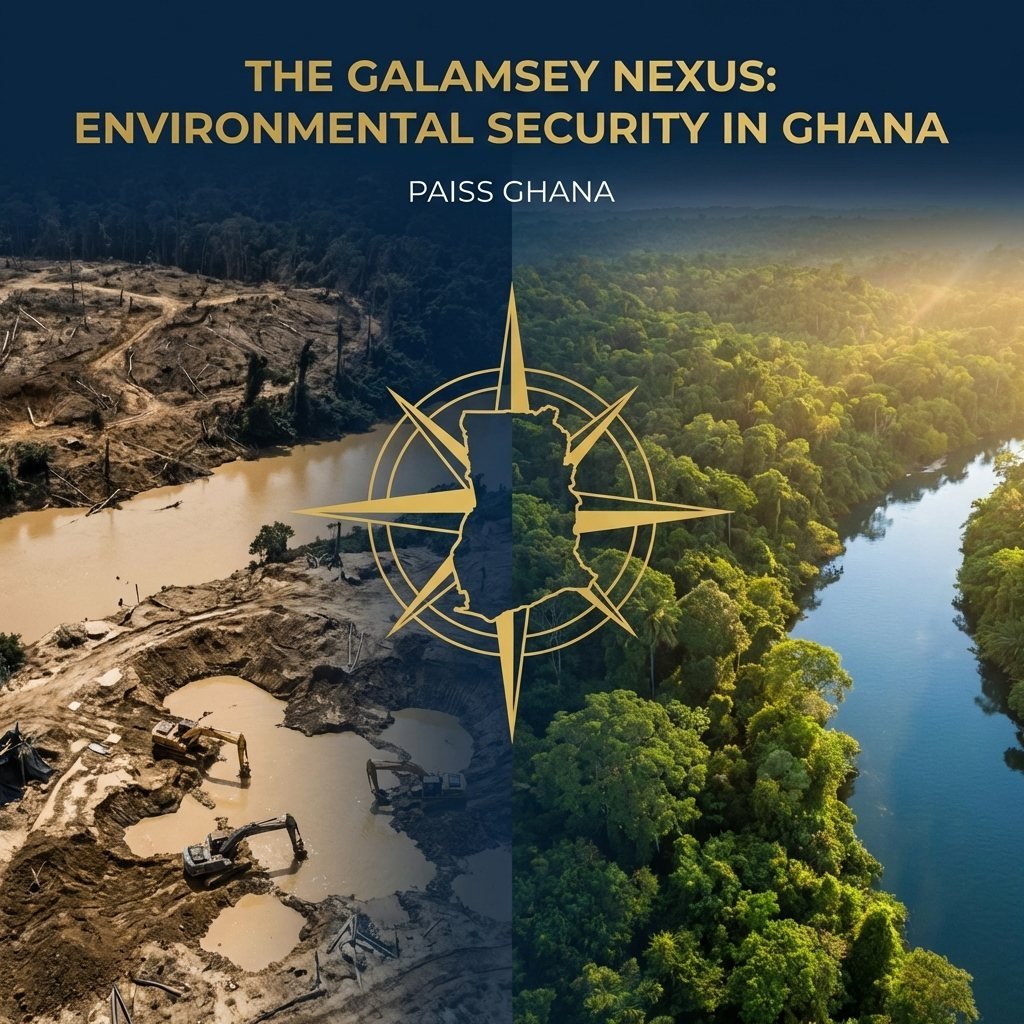
The Galamsey Nexus
Deconstructing Ghana's Illegal Mining Crisis and Charting a Path Towards Sustainable Governance
Executive Summary
Access the complete publication edition of the Galamsey Nexus Report as an official PDF document.
Illegal small-scale mining—locally known as "galamsey"—represents Ghana's most pressing environmental security crisis. This report provides a comprehensive analysis of illegal artisanal and small-scale gold mining (ASM), examining ecological devastation, public health impacts, economic consequences, and governance solutions.
Key Findings (At a Glance)
- Over 1,000,000 Ghanaians are directly involved in informal or illegal ASM gold mining.
- Historical tree-cover loss recorded across Western (432,000 ha), Ashanti (411,000 ha), and Eastern (246,000 ha) regions.
- Mercury contamination levels near localized illegal mining sites reached up to 500 times WHO drinking water guidelines.
- Illegal ASM gold smuggling trade flows estimated at US$2.3 billion annually (MLNR 2017 / World Bank).
- World Bank estimates annual health cost of ASM mercury exposure at US$240 million in Ghana.
The Scale of Destruction
Environmental Impact Assessment
Galamsey activities concentrate in Ghana's forest zones and along major river systems, particularly in Eastern, Ashanti, Western, and Central Regions. The environmental toll extends across multiple domains:
Water Resources Degradation
Rivers including the Pra, Ankobra, Birim, and Offin have transformed from clear waterways to turbid, mercury-laden streams unsuitable for human consumption or irrigation. Major water treatment facilities struggle to process contaminated raw water, forcing intermittent service disruptions affecting millions.
Deforestation and Land Degradation
Illegal miners clear forest reserves, cocoa farms, and farmland, leaving behind cratered moonscapes devoid of topsoil. Natural regeneration requires decades, while food security suffers as productive agricultural land disappears.
Biodiversity Loss
Critical habitats for endangered species including Forest elephants, West African manatees, and multiple primate species face destruction. Aquatic ecosystems collapse as mercury poisoning and sedimentation eliminate fish populations.
Public Health Crisis
The health consequences of galamsey extend beyond environmental degradation to direct human exposure to toxic substances and waterborne diseases.
Mercury Poisoning
Miners use mercury to extract gold, releasing it into soil, water, and air. Research in affected communities reveals alarming bioaccumulation:
- 67% of tested children show elevated blood mercury levels
- Pregnant women face heightened risks of neurological damage to developing fetuses
- Chronic exposure linked to kidney damage, cognitive impairment, and respiratory illness
Waterborne Disease Burden
Contaminated water sources contribute to elevated rates of diarrheal diseases, typhoid, and cholera in mining-affected communities. Healthcare systems strain under the additional burden.
Urgent Health Intervention
Launch comprehensive health screening program in 200 mining-affected communities, coupled with provision of alternative water sources and mercury chelation therapy for severely exposed populations.
Economic Analysis
The True Cost of Galamsey
While illegal mining generates estimated revenues of GH₵3.5 billion annually for operators, the broader economic consequences far exceed these gains:
Direct Costs
- Water Treatment: GH₵450M additional annual costs for treating degraded raw water
- Healthcare: GH₵280M treating mercury poisoning and waterborne diseases
- Agricultural Losses: GH₵620M from destroyed cocoa farms and foodcrop land
- Remediation: GH₵950M estimated cost to restore damaged sites (mostly unfunded)
Indirect Costs
- Lost tourism revenue from degraded natural attractions
- Reduced hydroelectric power generation due to silted reservoirs
- International reputation damage affecting foreign investment
- Long-term food security implications
Alternative Livelihoods Analysis
Many galamsey operators cite economic necessity, poverty, and lack of employment alternatives. Effective interventions must provide viable economic pathways:
Economic Transition Strategy:
- Invest GH₵800M in alternative livelihood programs (sustainable agriculture, forestry, aquaculture)
- Formalize artisanal mining through licensed community cooperatives with environmental standards
- Create 50,000 green jobs in afforestation and land restoration projects
Governance and Enforcement Challenges
Despite robust environmental laws, enforcement failures enable continued illegal mining. Multiple factors undermine governance:
Institutional Weaknesses
- Resource Constraints: Environmental Protection Agency and Minerals Commission lack personnel and equipment for effective monitoring
- Corruption: Bribery undermines enforcement at multiple levels from field officers to senior officials
- Political Interference: Electoral calculations sometimes override environmental priorities
- Inter-Agency Coordination Gaps: Fragmented responsibilities across multiple agencies create enforcement blindspots
Community Dynamics
Mining-affected communities present complex dynamics. While some residents oppose galamsey destruction, others depend on mining income or fear confronting powerful illegal operators backed by criminal networks.
Enforcement Enhancement
Governance Reform Package:
- Establish dedicated Environmental Crimes Investigation Unit within Police Service
- Deploy drone surveillance technology for continuous monitoring of mining regions
- Implement "follow the money" financial investigations targeting illegal mining profits
- Strengthen penalties: mandatory prison terms, asset forfeiture, and corporate accountability for equipment suppliers
- Create protected witness programs enabling community members to report illegal operations safely
Comprehensive Response Strategy
Addressing Ghana's galamsey crisis requires integrated action spanning enforcement, alternative livelihoods, remediation, and systemic governance reforms.
Multi-Stakeholder Action Plan
Phase 1: Immediate Enforcement (0-6 months)
- Deploy joint military-police task forces to halt operations in critical water catchment areas
- Seize and destroy excavators and processing equipment
- Prosecute 500 major illegal operators as deterrent
- Provide emergency alternative water sources to affected communities
Phase 2: Transition Support (6-18 months)
- Launch alternative livelihood programs reaching 100,000 former miners
- Begin land remediation prioritizing highest-impact sites
- Formalize artisanal mining in designated zones with environmental safeguards
- Strengthen monitoring using satellite imagery and AI detection systems
Phase 3: Long-Term Transformation (18-60 months)
- Restore 50,000 hectares of degraded land through afforestation
- Achieve mercury-free water quality standards in major rivers
- Establish sustainable mining sector generating formal employment
- Position Ghana as regional leader in responsible mining governance
Conclusion: Environmental Security as National Security
The galamsey crisis transcends environmental policy—it represents a fundamental threat to Ghana's national security, public health, economic prosperity, and social stability. Water scarcity, food insecurity, disease burden, and environmental displacement create conditions for long-term instability.
Yet pathways to recovery exist. With political will, adequate resources, and sustained implementation, Ghana can reverse environmental degradation while providing dignified livelihoods to those currently trapped in destructive mining practices.
The choice is clear: decisive action now, or irreversible environmental collapse threatening future generations. Ghana's leadership on this issue will determine not only the nation's environmental future, but set precedents for responsible resource governance across Africa.
Critical Call to Action
The window for effective intervention is closing. Without immediate, comprehensive action, Ghana risks permanent loss of critical water resources, irreversible ecosystem damage, and a generational public health catastrophe. National leadership must prioritize environmental security as a top-tier national security imperative, allocating resources and political capital commensurate with the existential threat posed by unchecked galamsey activities.
Sources, Methods & Limitations
Primary Sources & Citations
- [1] Illegal Gold Smuggling Trade Flow: World Bank, Ghana Landscape Restoration and Small-Scale Mining Project (P171933), Annex 5, pp. 131–133 (citing MLNR presentation, May 2017). Estimated US$2.3 billion in annual illegal gold smuggling.
- [2] Mercury Health Impact: World Bank, Ghana Landscape Restoration Project (P171933), Footnote 96. Estimated US$240 million annual health cost associated with mercury exposure in ASM communities.
- [3] Tree-Cover Loss: Global Forest Watch (GFW) historical regional export datasets (Western: 432,000 ha, Ashanti: 411,000 ha, Eastern: 246,000 ha; total Ghana: 1.75M ha). Note: GFW tree-cover loss reflects canopy change and is not synonymous with net deforestation without land-use driver analysis.
- [4] Economy-Wide Environmental Degradation: World Bank, Ghana Country Environmental Analysis (2020). Estimated US$6.3 billion overall annual cost of environmental degradation in Ghana.
Suggested Citation
PAISS Ghana. (2026). The Galamsey Nexus: Deconstructing Ghana's Illegal Mining Crisis and Charting a Path Towards Sustainable Governance (PAISS Publication Edition v1.1). Pan African Institute for Strategic Studies. https://paissghana.com/reports/galamsey-nexus.html
About PAISS Ghana
The Pan African Institute for Strategic Studies (PAISS) Ghana conducts rigorous policy research across criminal justice, cybersecurity, homeland security, and public governance. Our work informs evidence-based policy development across Ghana and West Africa.