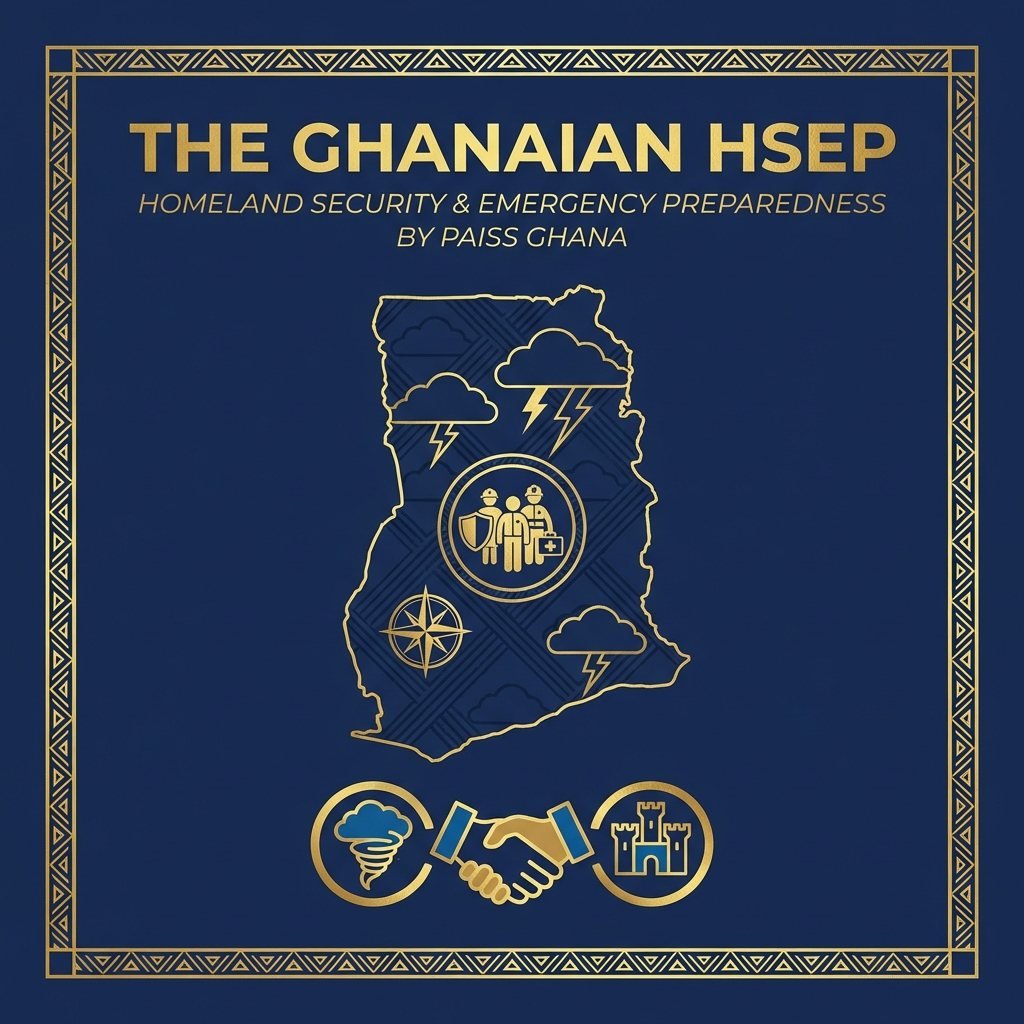
The Ghanaian HSEP
Homeland Security & Emergency Preparedness Assessment
Executive Summary
Access the complete publication edition of the HSEP Report as an official PDF document.
This report evaluates Ghana's homeland security and emergency preparedness (HSEP) infrastructure, assessing disaster management capabilities, inter-agency coordination, and climate resilience planning. Ghana faces mounting pressures from climate change, urbanization, and natural hazards that demand enhanced preparedness systems.
Key Findings
- 42 operational Emergency Operations Centers (EOCs) across 16 regions with varying capacity levels
- Climate-related disasters increased 78% over the past decade, primarily flooding and droughts
- Only 34% of districts maintain updated disaster management plans
- Average emergency response time of 45 minutes in urban areas, 3.5 hours in rural communities
Disaster Preparedness Assessment 2026
National Coordination Framework
Ghana's disaster management system operates through the National Disaster Management Organization (NADMO), supported by sector-specific agencies including the Ghana Meteorological Agency (GMet), National Fire Service (GNFS), and Ghana Health Service (GHS).
Capability Gaps
- Early Warning Systems: Limited real-time monitoring infrastructure for flood-prone areas
- Resource Pre-positioning: Insufficient strategic stockpiles of emergency supplies in high-risk zones
- Communication Systems: Gaps in redundant communication networks during infrastructure failures
- Training Standardization: Inconsistent emergency responder training across regions
Priority Recommendation
Deploy automated flood monitoring sensors in 50 high-risk communities within 12 months, integrated with SMS-based early warning system reaching 2 million residents.
Climate Adaptation Infrastructure
Ghana's climate resilience infrastructure spans flood control systems, drought mitigation, coastal protection, and agricultural adaptation. However, infrastructure development lags behind accelerating climate impacts.
Critical Infrastructure Needs
- Flood Control: Upgrade drainage systems in Accra, Kumasi, and Tamale to handle 100-year storm events
- Water Security: Expand reservoir capacity by 40% to buffer against prolonged droughts
- Coastal Protection: Construct seawalls and restore mangroves along 120km of vulnerable coastline
- Agricultural Resilience: Develop irrigation infrastructure serving 500,000 smallholder farmers
Adaptation Strategy Framework
A comprehensive climate adaptation strategy requires integrating physical infrastructure with policy reforms, community engagement, and regional cooperation. Key components include:
5-Year Adaptation Priorities:
- Invest GH₵2.4B in flood control and drainage infrastructure
- Establish 200 community-based disaster response teams
- Implement climate-smart building codes for all new construction
- Create GH₵500M Climate Resilience Fund for vulnerable communities
Flood Management Systems
Flooding represents Ghana's most frequent and destructive natural hazard, affecting an estimated 400,000 citizens annually and causing average economic losses of GH₵120M per year.
Risk Assessment
Ghana's flood vulnerability stems from multiple factors: inadequate urban planning, insufficient drainage capacity, deforestation in upstream watersheds, and unregulated development in floodplains. Climate change amplifies these pressures through increased rainfall intensity.
Annually
Economic Losses
Integrated Flood Management
Effective flood management requires structural interventions, early warning systems, land-use planning reforms, and community preparedness. Priority actions include:
- Construct detention basins and improve drainage capacity in flood-prone urban areas
- Enforce buffer zones along waterways prohibiting development
- Deploy real-time river level monitoring with automated public alerts
- Relocate 15,000 households from highest-risk flood zones with adequate compensation
- Implement nature-based solutions including wetland restoration and urban green infrastructure
Urgent Action Required
Launch accelerated drainage upgrade program in Greater Accra Region before 2026 rainy season. Estimated cost: GH₵450M. Projected benefit: 60% reduction in flooding incidents, protecting 200,000 residents.
Emergency Response Enhancement
Strengthening Ghana's emergency response requires investments in personnel, equipment, training, and coordination mechanisms to reduce response times and improve outcomes during disasters.
Response Capability Priorities
1. First Responder Capacity
Expand Ghana National Fire Service personnel by 35%, targeting underserved rural areas. Procure modern rescue equipment including hydraulic tools, thermal imaging, and water rescue gear.
2. Medical Surge Capacity
Establish 5 regional disaster medical caches, each capable of serving 10,000 patients. Train 500 healthcare workers in disaster medicine through annual exercises.
3. Logistics Coordination
Develop centralized logistics hub system for rapid deployment of emergency supplies. Pre-position relief items based on risk mapping and vulnerable population distribution.
4. Inter-Agency Coordination
Implement unified incident command system training for all response agencies. Establish quarterly multi-agency disaster simulation exercises testing coordination protocols.
Conclusion and Recommendations
Ghana's HSEP infrastructure demonstrates both significant achievements and critical vulnerabilities. While basic disaster management structures exist nationwide, climate change acceleration and urbanization pressures demand substantial capacity enhancements.
Strategic investments in early warning systems, climate adaptation infrastructure, and emergency response capabilities will build resilience protecting lives, livelihoods, and economic development. Success requires sustained political commitment, adequate funding, and collaborative action across government, private sector, and communities.
National Resilience Action Plan:
- Phase 1 (2026): Deploy early warning systems, update all district disaster plans, conduct national capacity assessment
- Phase 2 (2027-2028): Implement flood control infrastructure, establish community response teams, expand EOC capabilities
- Phase 3 (2029-2030): Complete climate adaptation investments, achieve regional leadership in disaster preparedness
About PAISS Ghana
The Pan African Institute for Strategic Studies (PAISS) Ghana conducts rigorous policy research across criminal justice, cybersecurity, and homeland security. Our work informs evidence-based policy development to strengthen institutions and improve public safety across Ghana and West Africa.